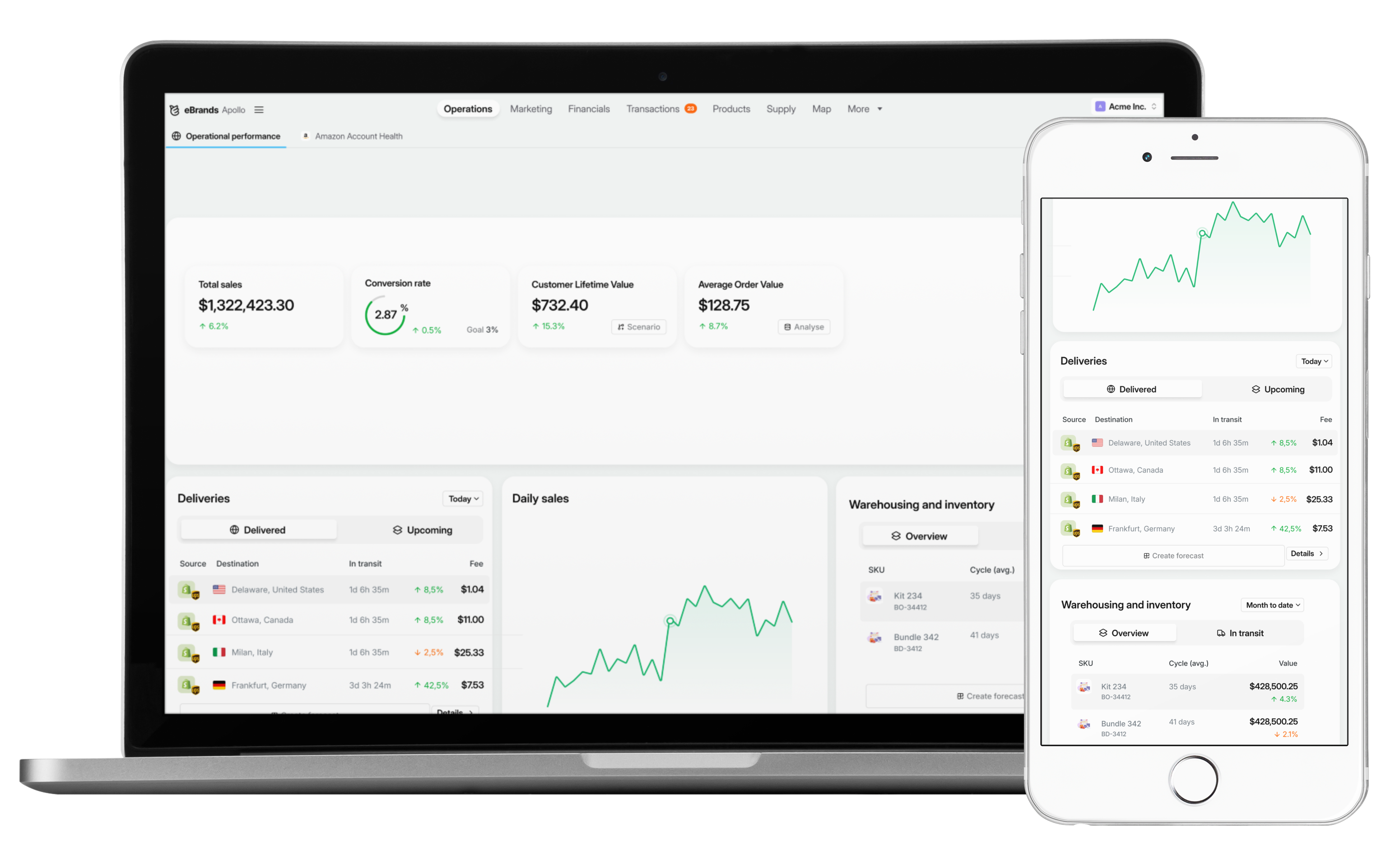
One view of your entire global operation
Apollo connects first-party and third-party data sources in real time.
Sales, inventory, fulfillment, and performance data from every channel — aggregated into one live view.
AI-driven predictions help you plan inventory, marketing spend, and channel strategy.
Track ad spend and performance across Amazon, Meta, Google, TikTok, and more.
Automated inventory distribution and fulfillment routing optimized for speed and cost.
One partnership replaces an entire back office
Expanding internationally typically means setting up local entities, hiring legal teams, managing VAT registrations, navigating customs, and integrating with dozens of platforms. eBrands replaces all of that.
➜ No local entity setup required in any market
➜ We handle VAT, sales tax, and duty remittance
➜ Integrated payments, fulfillment, and customer support
➜Real-time data via Apollo Intelligence dashboard
➜Live in new markets in weeks, not months
The intelligence layer that turns
commerce operations into compounding decisions
Most ecommerce brands operate on a 30-day decision cycle. Sales data lives in one place, ad performance in another, inventory in a third, financials in a fourth. By the time the monthly business review pulls them together, the data is 3-6 weeks stale and the decisions you make from it are reactions to a state of the world that no longer exists.
The brands that win internationally make decisions on a 24-hour cycle. They know which SKUs are scaling today, which channels are turning profitable, which markets are over-indexed on ad spend, which inventory positions need urgent intervention. They don't get there by working harder. They get there by running their operations on integrated real-time data.
Apollo is the intelligence platform that makes that possible. It's the fourth pillar of how we run a brand at eBrands, and it's the layer that makes the other three pillars (MoR, IoR, marketplaces) compound rather than just function.
What Apollo actually is
A unified data and decision platform that pulls every operational signal from your commerce operation into one place. Sales, inventory, ad performance, fulfillment, customer service, compliance, financials. Across every channel, every market, every SKU, every day.
It's not a dashboard. Dashboards show you what happened. Apollo shows you what's happening, what's about to happen, and what to do about it.
For brands we operate, Apollo is the default analytics layer. Everything we run on your behalf is visible to you in real time. For external partners using our Brand Partner Platform, Apollo is the surface where the operational intelligence becomes accessible.
What Apollo solves
Six categories of decision that brands typically get wrong because they don't have the data fast enough.
SKU economics. What's actually profitable per SKU per channel per market after every cost — COGS, shipping, fulfillment, returns, ad spend, marketplace fees. Most brands can't answer this question accurately. The brands that can are the ones making correct portfolio decisions.
Inventory positioning. Where stock is, where it should be, what's about to stock out, what's slow-moving and tying up working capital. Apollo flags this 7-14 days before it becomes a problem rather than 7-14 days after.
Channel mix optimization. Which channels are scaling profitably, which are plateauing, which are losing money. Where to push budget, where to pull back. The data per channel per market per stage of growth, not generic benchmarks.
Ad performance. ACoS, TACoS, conversion rates, click-through rates, share of voice — across every paid platform, with attribution that ties spend back to outcomes per SKU. Most brands manage this in 4-5 separate platform dashboards. Apollo collapses it.
Compliance and regulatory. Which markets your products are sold in, which compliance certifications are current, which are expiring, which regulations are changing in your operating markets. The work that's invisible until it's a problem.
Financial performance. P&L per brand per channel per market. Cash flow position. Working capital tied up in inventory. Settlement timing per channel. The financial picture that most brands rebuild from scratch every month in spreadsheets.
Why this matters for international brands
Operating in one market with one channel is a manageable operational problem. Operating in 8 markets across 12 channels is a different category of problem. The number of operational decisions per day grows exponentially. The cost of making them on stale or partial data grows with it.
The brands that successfully scale internationally aren't smarter. They have better information faster. Apollo is what lets a small commercial team operate a global commerce footprint without the data layer becoming the bottleneck.
How Apollo connects to the rest of the operation
Apollo isn't a separate product. It's the intelligence surface on top of the commerce operations we run. Every order processed, every shipment cleared, every ad served, every refund handled is captured automatically. The brand doesn't enter data into Apollo; Apollo reflects what's happening in the operation in real time.
That's why the model works. The data isn't being collected and reconciled after the fact. It's the operation itself, made visible. The decision quality improves because the information is fresh, integrated, and accurate.

.png)







Ready to go global?
Let us show you how eBrands can take your brand to every market that matters.